
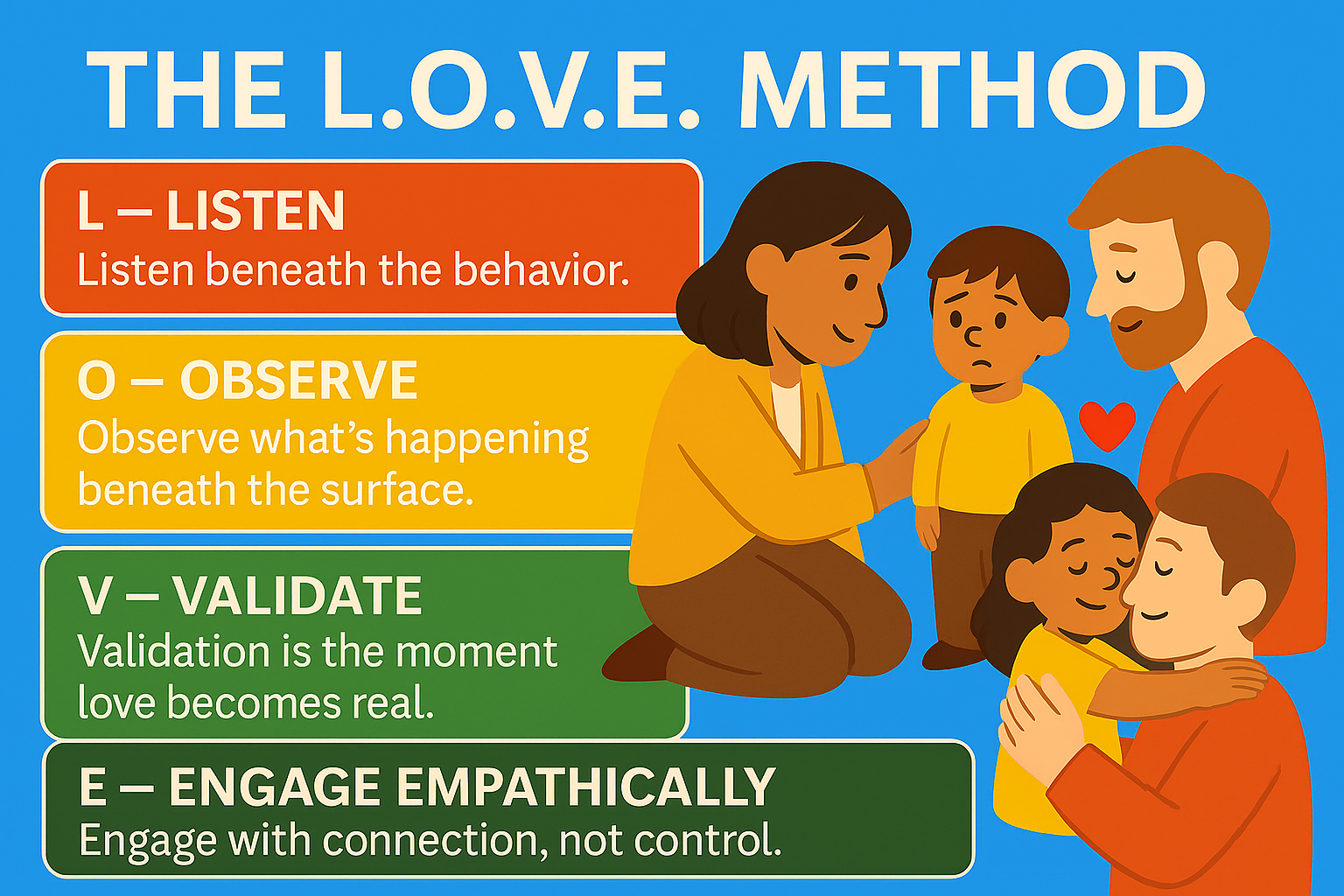
A practice of attunement, safety, and human connection.
The L.O.V.E. Method™ is the practical rhythm of the Love Loop, a daily practice for educators, parents, and leaders to build safety, trust, and emotional connection through attunement and connection.
It translates the science of the Neurorelational Love Model into real-world action, moment by moment, interaction by interaction, helping us move from theory to practice and from understanding to embodiment.
At its heart, the L.O.V.E. Method reminds us that every relationship is built one attuned moment at a time.
The L.O.V.E. Method – Listen, Observe, Validate, Engage Empathically – the practice layer of The Love Model.
It offers a simple, powerful practice for building trust and emotional safety in any relationship, from classrooms, to workplaces, to families.
Each step reflects the flow of attunement and co-regulation: slowing down, noticing, acknowledging, and responding with attunement and care.
The L.O.V.E. Method helps us turn theory into daily practice, restoring Love as the foundation for connection.
L — Listen
Listening is the first act of love.
It begins not with words, but with presence. When we truly listen, with our minds quiet and our nervous systems regulated, we signal safety to others.
Listening allows us to tune in to what’s really happening beneath the surface: the emotions, needs, and signals being expressed through tone, movement, and energy.
In a classroom, it looks like pausing before responding.
In leadership, it means hearing without defensiveness.
In parenting, it’s softening to understand before correcting.
Through listening, we regulate ourselves so that others can find calm in our presence.
O — Observe
Observation is the bridge between empathy and understanding.
It means noticing the cues, the body language, the rhythm of speech, the subtle signs of stress or safety that reveal what the nervous system is communicating.
To observe with love is to see behavior as communication, not defiance. It’s shifting from “What’s wrong with you?” to “What happened to you?”
By observing without judgment, we see the whole human in front of us, not just their actions, but their needs. This awareness allows us to respond with compassion rather than control.
V — Validate
Validation is how we turn understanding into connection.
It tells the brain and body: “You make sense.”
When we validate feelings – even difficult ones – we help the nervous system return to safety. Validation builds bridges of trust, teaching that emotions are not dangerous, but messengers.
For children, validation might sound like:
“It’s okay to feel sad. I’m here with you.”
For adults, it might be:
“That sounds really hard. I can see why you felt that way.”
Validation doesn’t mean agreeing; it means acknowledging. It transforms fear into safety and isolation into belonging.
E — Engage Empathically
Engagement is where love becomes action.
It’s the moment we meet another’s need through connection – eye contact, gentle tone, play, or co-regulation. It means responding not just with understanding, but with attuned care that reflects safety back to the nervous system.
Empathic Engagement invites curiosity, creativity, and joy. It reactivates the social engagement system, the part of the nervous system responsible for connection, learning and belonging.
In the classroom, empathic engagement looks like playfulness, shared wonder, and repair after rupture.
In leadership, it looks like collaboration, empowerment, and mutual respect.
In parenting, it looks like laughter after tears, the moment love rewires the nervous system for trust.
The Rhythm of Love
L.O.V.E. – Listen. Observe. Validate. Engage Empathically.
This is not a linear process, it is a living pracitce that keeps relationships flowing through trust, vulnerability, risk, rupture/ repair, validation, deeper trust and authenticity.
Each step strengthens neural pathways for connection, teaching the brain and body that love is safe, love is stable, and love can return after disconnection.
Through the L.O.V.E. Method, every moment becomes an opportunity to co-regulate, attune, and build emotional safety – the foundation of learning, creativity, and healing.
From Theory to Practice
The L.O.V.E. Method is used across education, leadership, and mental health systems to create environments grounded in empathy and safety.
It is how we move from understanding love as an idea to embodying it as a daily practice — shaping classrooms, workplaces, and homes where people feel seen, heard, and valued.
Because when we lead with L.O.V.E., we don’t just change behavior we change biology.