
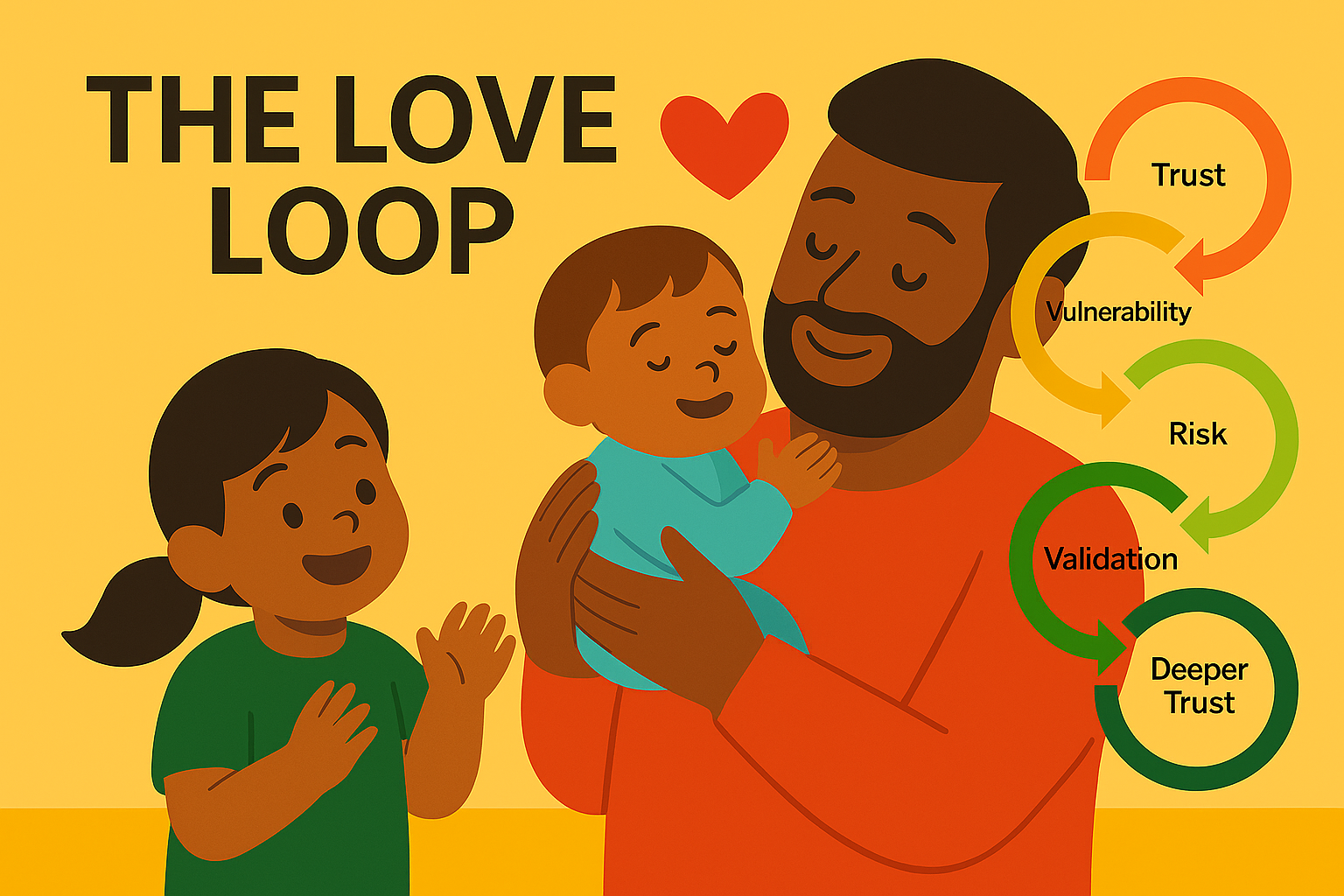
A dynamic cycle of trust, vulnerability and growth.
At the heart of the Neurorelational Love Model, is the Love Loop, a dynamic cycle that explains how love builds the foundations for safety, healing and authentic connection.
The Love Loop is more than a concept it is biological and relational process. It describes how trust and vulnerability work together to regulate, rewire the nervous system for connection.
It unfolds as a repeated cycle in every meaningful relationship, between parent and child, educator, and student, mentor and mentee, or even within ourselves.
The Cycle of Love
Trust → Vulnerability → Risk → Validation → Rupture/ Repair → Deeper Trust → Authenticity
Each stage represents a neurorelational process through which safety, openness and love deepen:
Trust
Trust is the entry point, where love begins.
It is the nervous system’s signal that it is safe to engage.
When we feel seen, heard, and understood, our brain’s parasympathetic system activates, allowing calm and connection. This physiological safety becomes the foundation for all learning, creativity, and love.
Trust is not built though perfection, but through attuned, consistence moments that tell the brain and body you are safe here.
Vulnerability
Once trust is established, vulnerability becomes possible.
In this stage, the nervous system dares to soften. We allow ourselves to be seen more fully, not just what we do, our strengths, but for who we are, including our needs and emotions. Vulnerability is a gift of the nervous system, signalling safety enough to risk exposure, supporting true connection by allowing authenticity to emerge.
Risk
Vulnerability naturally leads to risk, the step where growth happens.
Risk doesn’t always look dramatic; it can be as simple as a child trying something new, an educator pausing instead of reacting, or a leader admitting uncertainty.
The sympathetic nervous system briefly activates to help us stretch beyond our comfort zone. When this risk is met with empathy and safety, the nervous system learns: expansion is safe.
Healthy relationships create “safe uncertainty”, environments where risks lead to learning, not shame.
Rupture
Every relationship experiences rupture, moments of misunderstanding, disconnection, or emotional distance.
These moments activate the brain’s threat system, signaling danger to the nervous system. For children, this may look like withdrawal, defiance, or tears. For adults, it might feel like shame, anger, or disconnection.
But rupture is not failure, it is part of the loop. Each rupture offers an opportunity for growth, if it is followed by repair.
Repair
Repair is where love deepens.
When we acknowledge hurt, take responsibility for rupture, and reconnect with empathy, we teach the brain a vital truth: connection can survive disconnection.
This process of repair releases soothing neurochemicals and reactivates the social engagement system, restoring regulation, safety and trust. Over time, repeated repair strengthens neural pathways of resilience, empathy and emotional intelligence, showing that love is not defined by perfection, but by the courage to return, to see and to reconnect.
Deeper Trust
Through repair, trust grows stronger.
The nervous system learns not only that love is safe, but that love can be restored. This deeper trust is the foundation of emotional security and the heart of all healthy relationships, it allows for more vulnerability, greater authenticity, and deeper intimacy.
With every cycle, the Love Loop strengthens the neural architecture of safety, belonging, and creativity, both in children and adults.
Authenticity
Authenticity is the outcome and renewal of the loop.
When our nervous system has experienced trust, vulnerability, risk, and validation, we become more grounded in who we are. It is the state of being where our inner world and outer expression align. Authenticity allows us to show up fully, to love, learn, and create without fear of rejection.
Authenticity, nourishes belonging, and becomes the foundation for mutual trust.
Why It Matters
The Love Loop is a neurorelational rhythm that helps us understand how love shapes the brain and relationships over time. It moves us beyond trauma-informed care into love-informed transformation from protection to participation, fear to flourishing, survival to joy.
When we lead, teach, or parent through the Love Loop, we don’t just manage behavior, we nurture brains, hearts, and communities that are wired for connection.
Transforming relationships into spaces of psychological safety, creativity, and belonging. It helps children and adults alike move from protection to participation — from fear to flourishing.
Love is a loop, not a line.
It’s a cycle of safety and expansion that helps us grow into our most authentic selves and teaches us how to create the conditions for others to do the same.